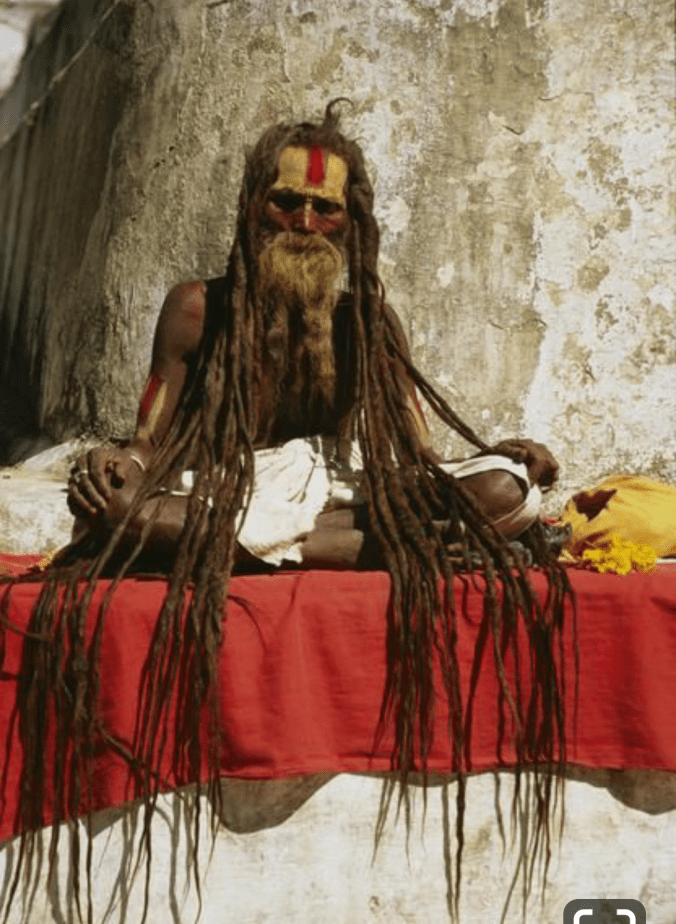
Shiva with dreadlocks.
The history of dreadlocks is varied and differs depending on who you ask. This, then, is a summary and compilation of all the different accounts we have been able to locate.
One account claims that dreadlocks originated in India (unlike most who cite Egypt as their birth place) with the dreadlocked diety Shiva and his followers. It is likelythat this is the spirituality origin of dreadlocks in Indian culture. However, the first archeological proof of people wearing dreadlocks came from Egypt where mummies have been recovered with their dreadlocks still in tact.
Regardless of their origin, dreadlocks have been worn by nearly every culture at some point in time or another. Roman accounts stated that the Celts wore their hair ‘like snakes’. The Germanic tribes and Vikings were also known to wear their hair in dreadlocks. Dreadlocks have been worn by the monks of the Ethiopian Orthodox Tewahedo Church, the Nazarites of Judiasm, Qalandri’s Sufi’s, the Sadhu’s of Hinduism, and the Dervishes of Islam, and many more! There are even strong suggestions that many early Christians wore dreadlocks; most notably Sampson who was said to have seven locks of hair which gave him his inhuman strength.
Israeli musicians depicted wearing their hair in dreadlocks. They associated dreadlocks with pride, music, and power. (Much like many modern-day hip-hop and reggae artists.)
The belief that dreadlocks gave a person power is not unique to this Bible story. Many believed that energy (presumably life force energy, chi, prana, ki, etc.) exits the body through the top of the head and that having knotted hair prevents or retards the escape of energy making one stronger and even potentially imbuing a person with supernatural mental and physical abilities. In many cultures it was and is common for shamans in particular to wear dreadlocks. Dreadlocks have also symbolized the recognition and demonstration that our physical appearances and vanity are unimportant. Another, similar practice is having a shaved head with no hair at all. Others still believe that dreadlocks are the most natural and healthy style of hair to have as hair will dread if left to its own devices.
Ras Tafari
At the beginning of the Industrial Revolution Rastafarianism began gaining popularity among the Black Jamaican population. Rastafarianism draws its belief from three main sources; the Old Testament, African tribal culture, and Hindu tribal culture. Before it got the name ‘Rastafarianism’ its followers called themselves ‘dreads’, signifying their ‘dread’ and respect for God. In an attempt to emulate the Nazarites and Hindu holymen their beliefs were modeled after, they began to wear their hair in matted styles and this is when the term ‘dreadlocks’ came into common use. Rastafarianism began to draw attention when in the 1930’s Ras Tafari was crowned the emperor of Ethiopia. He was forced into exile and many vowed not to cut their hair until he was released.
The association of dreadlocks with marijuana smoking also began with the Rasta movement which contended that smoking it facilitated clear-thinking. It still holds true today that many dreadheads (caucasian more than Rastas) are pro-marijuana. However, there are other sects of Rastafarianism who believe any sort of mind-altering substance is impure and also restrict the consumption red meat and alcohol. These same purists suggest that Bob Marley and his extreme pro-marijuana stance damaged the reputation of Rastafarianism.
Marley, himself, identified as a Rastafarian and it was his dreadlocked style that brought the style into the mainstream where it has expanded into many other subcultures. They have become especially popular among New Age travellers (Pagans, especially, who travel from festival to festival across the country), hippies, vegans, goths, and cyber goths. Additionally, dreadlocks have become highly popular among the subculture of jam bands, such as the Grateful Dead and Phish,
Dread heads today have varied reasons for chosing to wear their hair in dreads. Some of them are based in spiritual purposes such as suggested above, others because they identify as Rastas, and others simply because they love the look! More importantly than what your reason is, is knowing your reason so that someday when someone asks you WHY you put dreads in your hair you can say without a doubt why you have dreads and what your dreads mean to you!